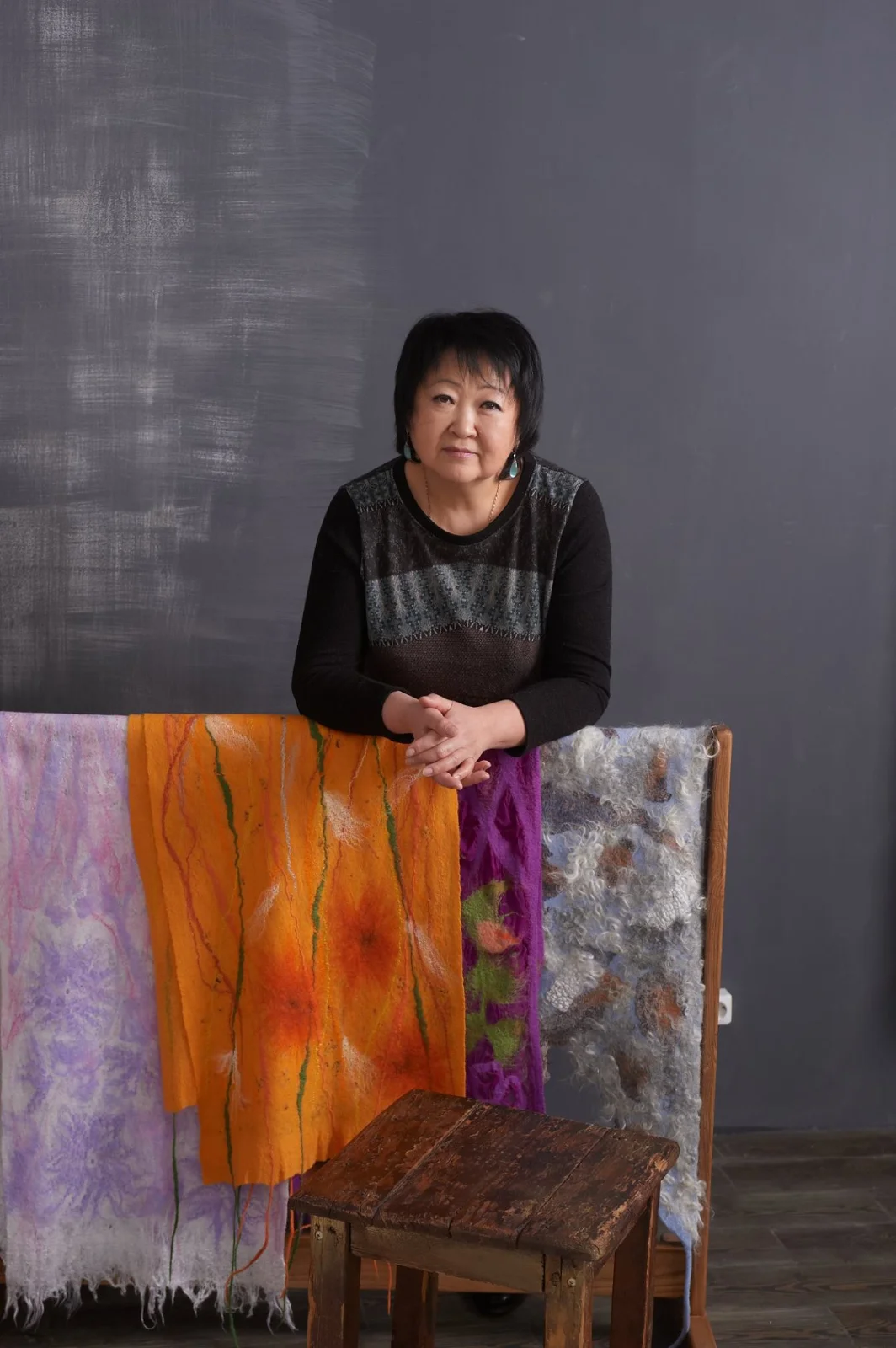
A Double Life
It is worth starting with what Liudmyla is not by training. She has no art education. She is a shipbuilding engineer,
a commodity specialist, an organizer of trade processes, a business trainer. For many
years she was a top manager at national companies.
"For a very long time I led a 'double life': in public — a top manager at national companies, at home
— a creator with an easel and paints. Work by day, creativity by night, and in the morning back to work, good as
new."
Her engineering education turned out to be not an obstacle but an unexpected advantage. Ships are built from
drawings: precision, proportions, volume, structure. Liudmyla says that this is exactly what helps her see
"how a plane takes on form, how volume, texture and composition interact." The only difference is that
steel obeys the drawing, while wool does not. So creativity taught her something else: to leave room for
intuition and for the freedom that the material gives.
The Grandmother Who Put Things Aside
Where does the need to create come from in a person who runs a business during the day? Liudmyla answers
with a memory from childhood.
The family was large, and her grandmother worked around the house almost without a break. But as soon as the TV
began the programme "Creativity of the Peoples of the World," she put everything aside.
"This memory has stayed with me forever: amid daily cares she found time for beauty
created by human hands. I think it was my grandmother who sowed in me the little seed that later
grew into my life's work."
The Technique Is Only Thirty Years Old
The word "nunofelting" sounds as if it were several centuries old. In fact the technique is quite young: it was
developed by the Australian artisan Polly Stirling in the early 1990s. "Nuno" in Japanese means
"fabric." The idea is simple and at the same time bold: not to felt wool by itself, but to work it into a light
fabric, so that a thin felt results that can be worn even in warm weather.
Liudmyla returns to it again and again:
"I especially love working with natural silk: I am captivated by the combination of its lightness with
the plasticity of wool, the possibility of creating expressive textures and subtle transitions."
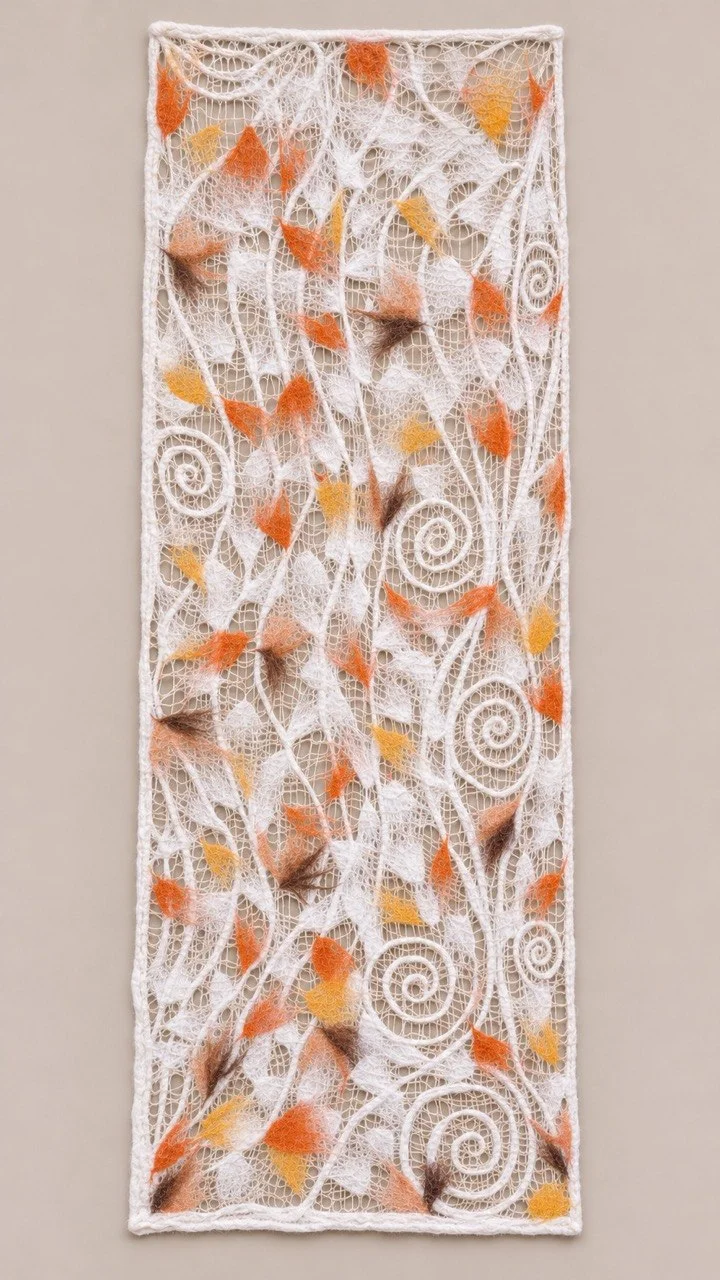
Out of this search grew "Richelieu in Felt." For her, the main thing here is the conversation between dense and transparent:
"the openwork gaps become as expressive a part of the composition as the fabric itself."
Ten Years Without a Single Repeat
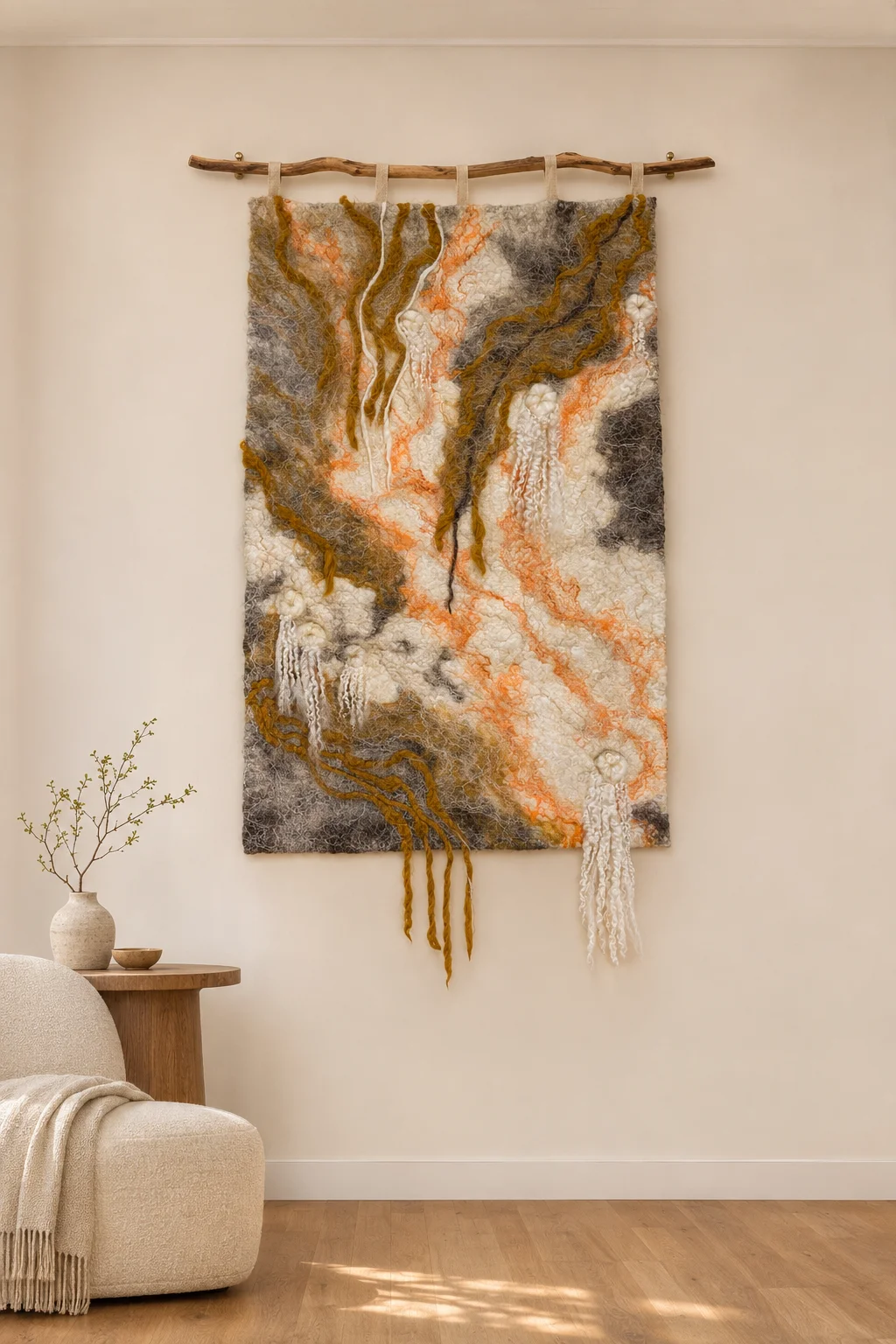
In almost ten years Liudmyla has not made a single copy. She almost never takes commissions: a work
must be born from inner need, not from someone else's technical brief. That is why every stole
exists in a single copy.
The Storks Return Home
The Kherson region is the place Liudmyla calls her roots. The Kyiv region, Transcarpathia and travels
give her colours and moods: Florence, Montserrat, Gaudí's Barcelona, peaceful Ireland. Among artists
she feels closest to Renoir, for his light and warmth. She once posed for the Kherson
artist Oleksandr Shtyrmer and so saw the creative process from the other side of the canvas.
Lately Liudmyla has again been working together with the Kherson artist Yuliia Shevchuk-Schneider.
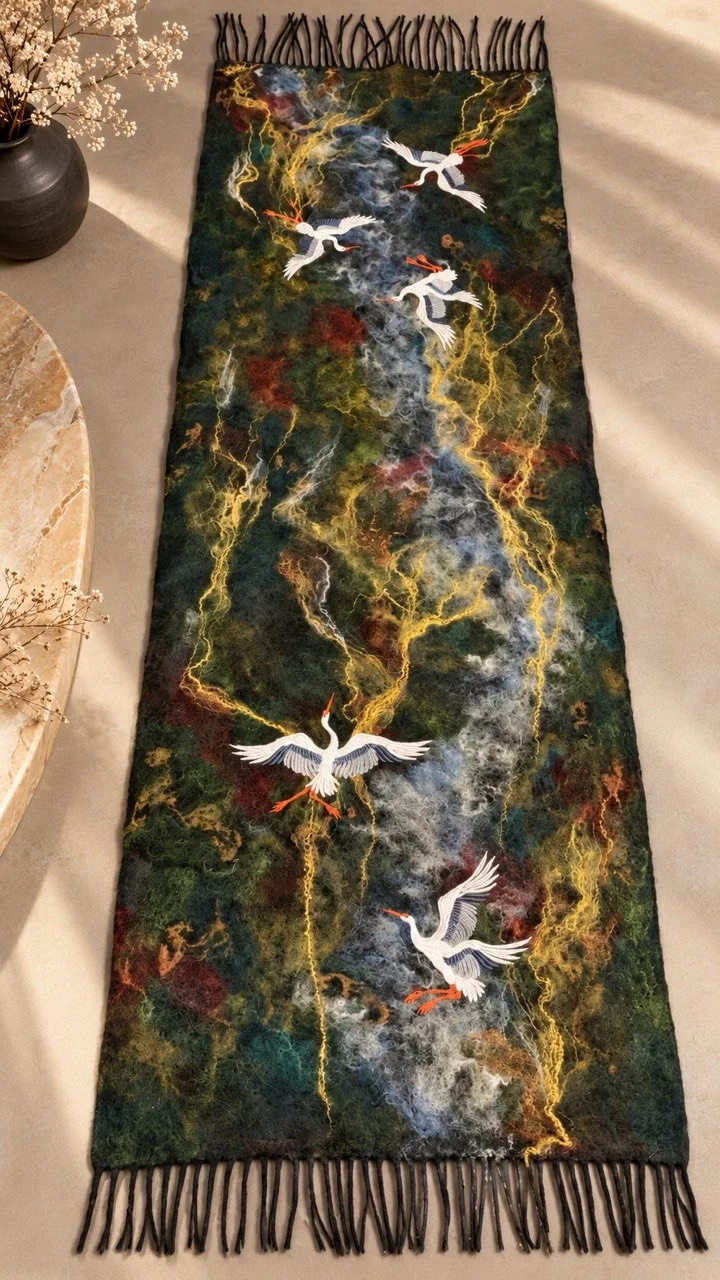
The result of this collaboration can be seen on CodeKY: the stole "Wings of Hope." On it there is night, thunder and
lightning across the whole sky, and through the storm fly storks, a pair with three chicks. The storks in it
mean hope and returning home.
She describes her working day in a way that makes one a little envious:
"My creative day begins as soon as I open my eyes and lasts until I sleep: even
as I fall asleep, I am mentally creating the next work." Beside her is her husband, the founder of a company, who has taken on almost all the household chores. "Though we are two
'tigers'," Liudmyla laughs. Both are leaders, so living together, she says, is also an art: learning
to give each other space.
And how does she know a work is finished? Her answer is theatrical:
"I feel a work is finished when I have given it everything I could and have nothing more to add. <...> As
they say: 'Curtain — the performance is over.'"
Stoles That Live Far from Home
Liudmyla has not yet had shows abroad. But her works already live in the USA, France, Germany,
Spain, Poland, Sweden, South Korea. Behind each one stands its own story.
A friend in the USA has lived outside Ukraine for over thirty years, and for her Liudmyla's textiles became
a piece of home. In Germany, her sunflowers live with an educator from Ukraine. One of the first commissions
came from an unfamiliar woman from Germany who, as it turned out, works in the world of fashion, at Armani.
And one of the very first works went to the USA, to Emiliia Ponomarova, then already a well-known felt
artisan.
"For me, then still a beginner, this was an important sign: my works had attracted the attention of people with
an experienced professional eye."
What's Next
Liudmyla is now working on a series of three-dimensional textile panels, "Presence of the Living," about the world of
flora and fauna. The first work, "Breath of the Earth," is already finished. She has also received an invitation to the XIII
festival "Tavriia Arts Week 'Zabalka'," which runs from 7 November to 13 December 2026.
This festival is no accident for her. Back in 2020, the Oles Honchar Kherson Regional Library, as part of "Zabalka,"
spoke with Liudmyla as a felting artisan. The talk was then titled "Felt — Gentle, Practical, Historical."
Liudmyla's advice to those buying an original work for the first time:
"Listen to your own feeling: whether this work resonates with you, what emotions it evokes, whether
you want to be near it."
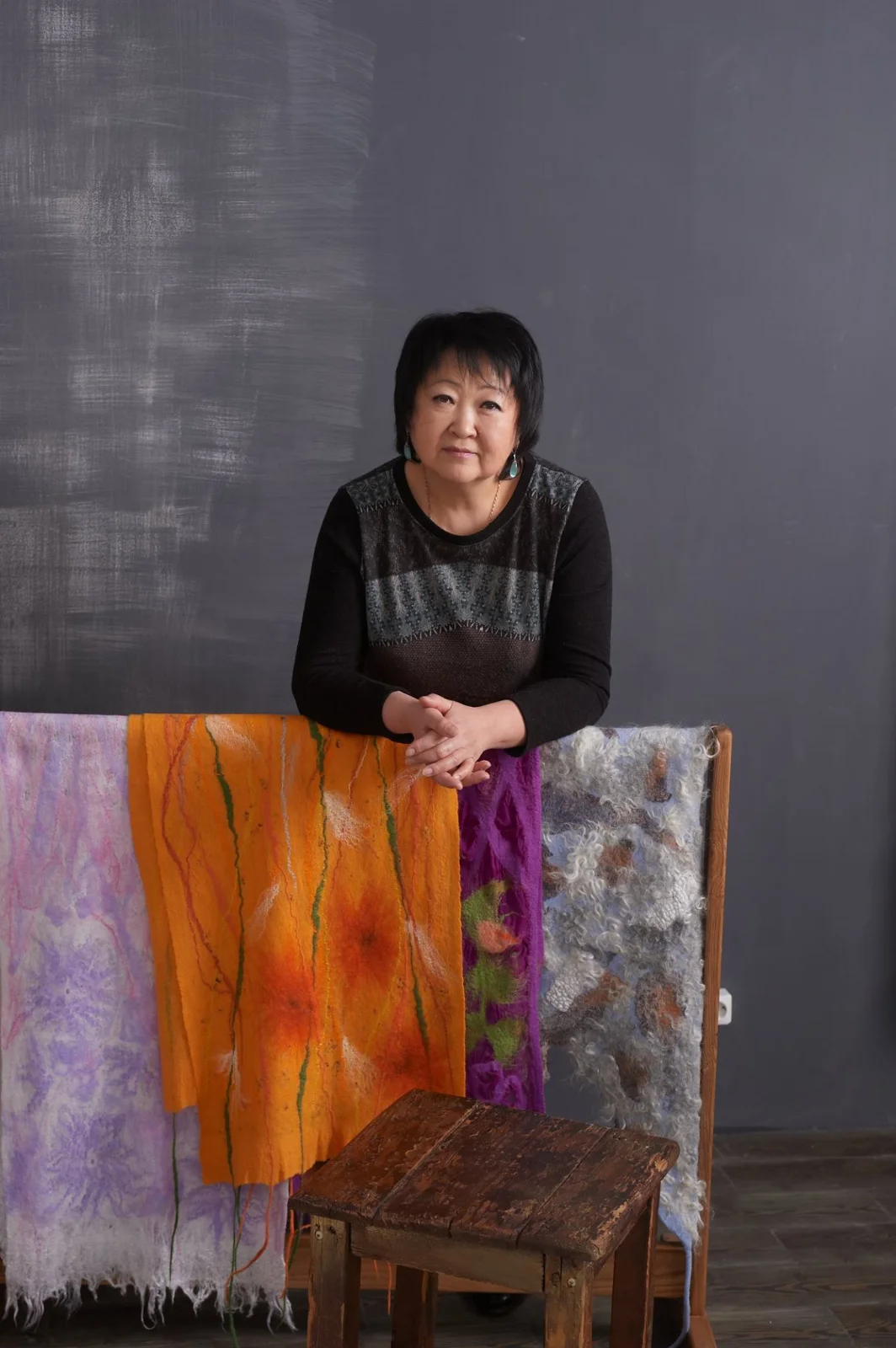
She describes her creativity in three words: love, freedom, uniqueness.
Works by Liudmyla Barna on CodeKY
"Lace of Silence" — white lace in the "Richelieu in Felt" technique: Italian merino and ultra-thin
silk. The transparent areas let the light through.
"Wings of Hope" — storks above a stormy sky, embroidery by Yuliia Shevchuk-Schneider.
"Palette of Feelings" — burgundy, green and gold on black, with black fringe.
Each stole is one of a kind.